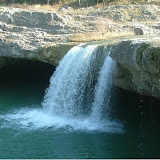
Zarečki krov (Zarečje's roof) is one of the waterfalls on the Pazinčica stream. All waterfalls on Pazinčica have this characteristic shape - a cave below the waterfall. That's why they are all called "roofs". This is the biggest of all "roofs", and also the most beatifull. Zarečki krov is also popular swimming and waterpolo place, and because of cave below and high clifs it is also nice climbing place. If you want to visit it, take the old road from Pazin toward Cerovlje, and just after last houses of Pazin, on the left side is a tiny road that takes you to this beautiful waterfall.
The vampire of Kringa first appeared in text form in 1689. The Kringa vampire story evolves around a Kringa inhabitant by the name of Jure Grando (Giure Grando). For 16 years after his death and burial in Kringa Jure Grando terrorised Kringa, notably his widow ( who as legend would have it was forced to continue fulfilling her marital duties) other Kringa residents and relatives were molested. Rumour has it that the vampire of Kringa, Jure Grando , would rome the streets of Kringa at night, knocking on doors, these residents who answered would soon after die. In 1672 nine Kringa villages decided enough was enough, carrying the cross, lamps and hawthorn stick they went to the grave of Jure Grando. On opening the grave it is said that the body was intact and was lying still staring up at them. The 9 Kringa villages attempted to destroy the body. There first attempt of driving a hawthorne stake through him failed but eventually and after some exorcism prayers, the body of Jure Grando was decapitated by Stipan Milasic with a saw, the vampire screamed and blood started to flow, and soon the entire coffin was full of blood. In 1656 the vampire of Kringa died , but it was not till 1672 was decapitated as a vampire in .In the village of Kringa amongst the many stone cottages you will see large crosses erected for defence and the local bar is aptly named the vampire bar.
Sitting in a red velvet chair in the "Vampire" bar, decorated with garlic wreaths and lamps with crosses, Mladen Rajko explains how local tourist authorities launched a project last year called "Jure Grando, the Vampire from Kringa". "No one is claiming that vampires or evil forces exist, all we want is to promote a documented legend in order to boost what we can offer tourists," says Rajko, head of the nearby municipality of Tinjan.
Visit Vampire bar in Kringa by tourning right on the road Poreč-Pazin, just before Tinjan and folow the signs.
Vodnjan is a sleepy Istrian village that contains one of the region's most macabre sights. There's not much to see in the tiny town except for the Baroque 18th-century Church of St. Blaise (sveti Blaž). Pleasant enough on the outside, it's the interior that draws visitors.
Behind the main altar of lie the desiccated remains of six saints that were, in effect, mummified. The clothed bodies of St. Leon Bembo, St. Ivan John Olini, and St. Nicoloza Bursa, as well as assorted parts of three other saints, lie enclosed in glass. For unknown reasons, the bodies and body parts failed to decompose. The skin and nails darkened and dried, making the corpses look curiously wooden. In addition to the "mummies", the church reliquary contains 380 relics enclosed in glass, including the undecayed tongue of St. Mary of Egypt.
It is believed that the body of St. Nicolosa, Benedictine nun who died in Venice in 1512 is the best preserved mummy in Europe. Bioenergy healers have proved that the body of Nicolosa Bursa emits a 32-meter bioenergy circle. It is also said that there have been 50 miraculous healings in the body's close proximity.
The collection of mummies was brought to the church in Vodnjan 180 years ago, when fleeing from the perils of war it was brought from Italy by Gaetano Gresler. How these bodies, which were not embalmed, have failed to decompose and have been preserved until today (the oldest dates from the end of the 12th century) - still remains a mystery.
Rt Kamenjak is the southest point of Istrian peninsula. It is located in Premantura, a beautiful turistic place, 10 minutes of ride from Pula. On Kamenjak you can enjoy in clearest waters, canions and magnificent view, and beaches are never crowded. At night you can refresh yourself at unique caffe bar "safari bar" all made of natural materials that even offers fun for the youngest, great sangria and posibility to enjoy the magical stary night not "infected" by the city lights. Pictures of safari bar:
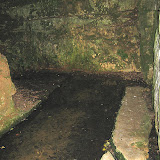
Puc or Puč is small water source near village Vošteni, Sveti Lovreč. It is cca 10 meters under ground surface. The water goes underground all to Lim bay. According to people stories it is discovered a long time ago by a cow who went down to drink. After that people build stone stairs and probably the water was used for drink, washing and cooking. Today the place is a little unarranged, there is no signs, so it is hard to find it if you dont know exactly where it is. Photos:
There are not many such beautiful and exciting dead towns located so near an urban area like Dvigrad in Istria. It was not destroyed by some military power, or devoured by fire; it was rather abandoned by its inhabitants to undergo its solitary death. Dvigrad is situated in Draga - a deep valley that stretches from Pazin to the sea, ending in a sea chanel - Lim. Dvigrad - as its name implies - consists of two towns. Today, only one town can be seen on the norhtern side of the valley, and it is in ruins. About the year 1630 the town was completely deserted. When the church of St. Sophia got abandoned in 1714, the town was left to its inexorable fate. We can enter Dvigrad through the city gate which has remained intact, and we reach the lower town which was protected by the first ring of the city wall. Following the way that Dvegrajci (as the inhabitants of Dvigrad are called in the Istrian memoirs) used to take for centuries, we arrive at the second gate, built in the second ring of the city wall. That's how the town was actually entered: from one gate to the another. We follow the way up to the third and the last gate, passing by an enormous guard tower situated in the southern part of town. Throught this gate we finally reach the centre of Dvigrad. On this highest position, as on a living rock, the early Christian church of St. Sophia was erected. It dominated the town due to its height, width and beauty. It had three naves, and in its centre, leaning against the pillars of the middle nave, a pulpit was constructed in the 13th and 14th centuries. The pulpit’s brim was decorated by beautiful reliefs. The most remarkable of them is the relief depicting St. Sophia holding one town in each hand. This is the symbol of Dvigrad. At the beginning of the 19th century the basilica collapsed, the roof fell in, and from that time on, this magnificent building has completely deteriorated. At the end, the question remains how much longer this deceased town will bear witness to the time, how much longer it will take before it has completely perished. Photos:
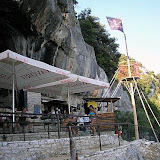
So called pirate's cave is supposedly associated with pirate Captain Morgan who traveled by his ship a long time ago trough Lim Bay. The cave is situated on the coast of Lim Bay (Limski Canal) - a wonderful region, densely covered with evergreen and deciduous trees, home to badgers, foxes, deer and wild boar. The Lim bay and valley is a peculiar geographic feature found near Rovinj and Vrsar on the western coast of Istria, Croatia, south of Porec. The name comes from the Latin limes for "limit", referring to the landform's position at the border of two Roman provinces (Dalmatia and Italia). The Lim valley (Limska draga or Limska dolina) is the 35 km long valley of the river Pazincica, which transforms into the Lim bay (Limski zaljev), a 10 kilometers long estuary. It is often called "Limski Fjord", or also "Lim fjord". Although the movie The Vikings starring Kirk Douglas was shot there in 1958, it is not a fjord but a ria, since it was not carved by a glacier but by the river eroding the ground on its way to the Adriatic Sea when the sea level was lower. Due to its narrow width it is also referred to as the Lim channel (Limski kanal). In the smal pirate's cave there is a bar where you can buy drinks and enyoj beutiful view:
On this blog you can read about Istria - Croatian peninsula at the head of Adriatic sea. I will show you hidden places that you wont find in any tourist guide, pictures of small villages in heart of Istria, videos of attractions, beautiful nature and much much more... Visit Istria, and feel the magic of blue and green!